Masafumi Endo

Research Scientist · Activity Understanding Team, CyberAgent AI Lab

I am a Research Scientist on the Activity Understanding Team at CyberAgent AI Lab. I have long been passionate about building embodied intelligence that brings robots into human society.

During my Ph.D. at Keio University, advised by Prof. Genya Ishigami, I worked on risk-aware robotic autonomy for rough-terrain exploration, with a focus on planetary rovers. I now work on embodied AI for everyday scenarios, focusing on decision-making and scene understanding.

Before joining CyberAgent, I interned at NASA JPL, Field AI, and OMRON SINIC X.

  • Planning under Uncertainty
  • Scene Understanding
  • Integrated Planning and Learning
  • Foundation Models for Robotics
  • Planetary Exploration
Masafumi Endo

News

Selected Publications

arXiv 2026

Commonsense-Grounded Path Planning from Abstract Instructions

M. Endo, K. Honda, and R. Yonetani

arXiv preprint, 2026

arXiv
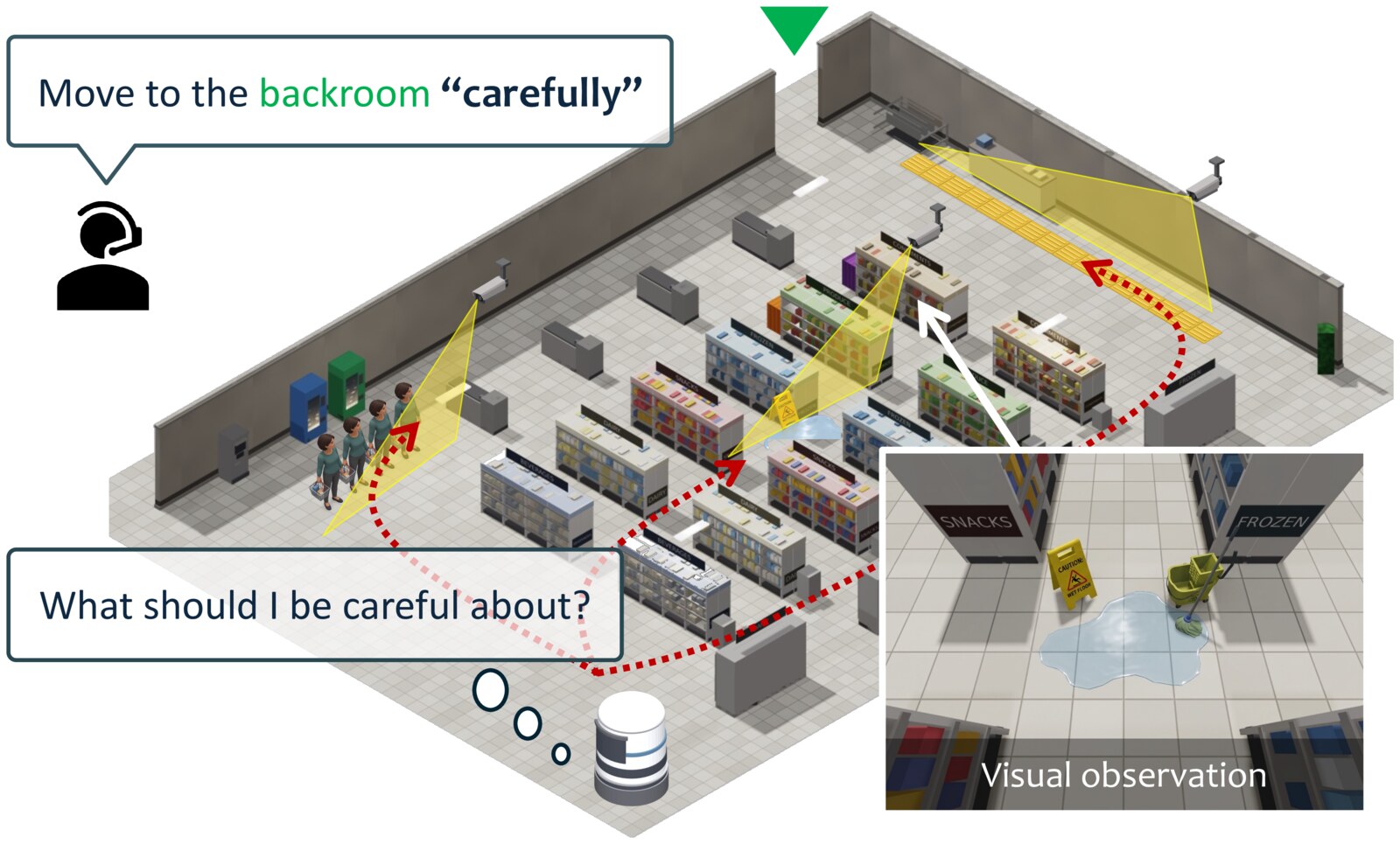
We present commonsense ranked search (CoRS), a novel path planner that turns an abstract instruction into a route that follows commonsense. While existing methods respect the considerations written down in advance, a robot working among people must follow those left unstated too, as with a wet floor that a worker avoids without being told. CoRS leverages large language models (LLMs) and vision-language models (VLMs) as commonsense knowledge to reason about these latent considerations in its planning. Given an abstract instruction (e.g., “move carefully”) and visual observations of each region in the environment, CoRS derives a consideration for each region, as in “this wet floor is slippery and worth a detour.” It then compares the considerations between regions to see which of the two the robot should avoid more, as in “the crowd is worse than the wet floor.” These judgments sort the regions into a commonsense ranking, whose costs drive a conventional search that always returns a valid route. We build a benchmark for planning under latent considerations, with three environments, 1350 problems, and five instructions at three levels of abstraction. Experiments show that CoRS discovers the unstated considerations and goes around the ones worth a detour while crossing the rest, a behavior that recent LLM-based planners do not achieve.
arXiv 2026

Orienteering Problem with Uncertain Time-Varying Rewards: Framework and Benchmark for Everyday Service Robotics

M. Endo, K. Honda, Y. Jinnai, and R. Yonetani

arXiv preprint, 2026

arXiv
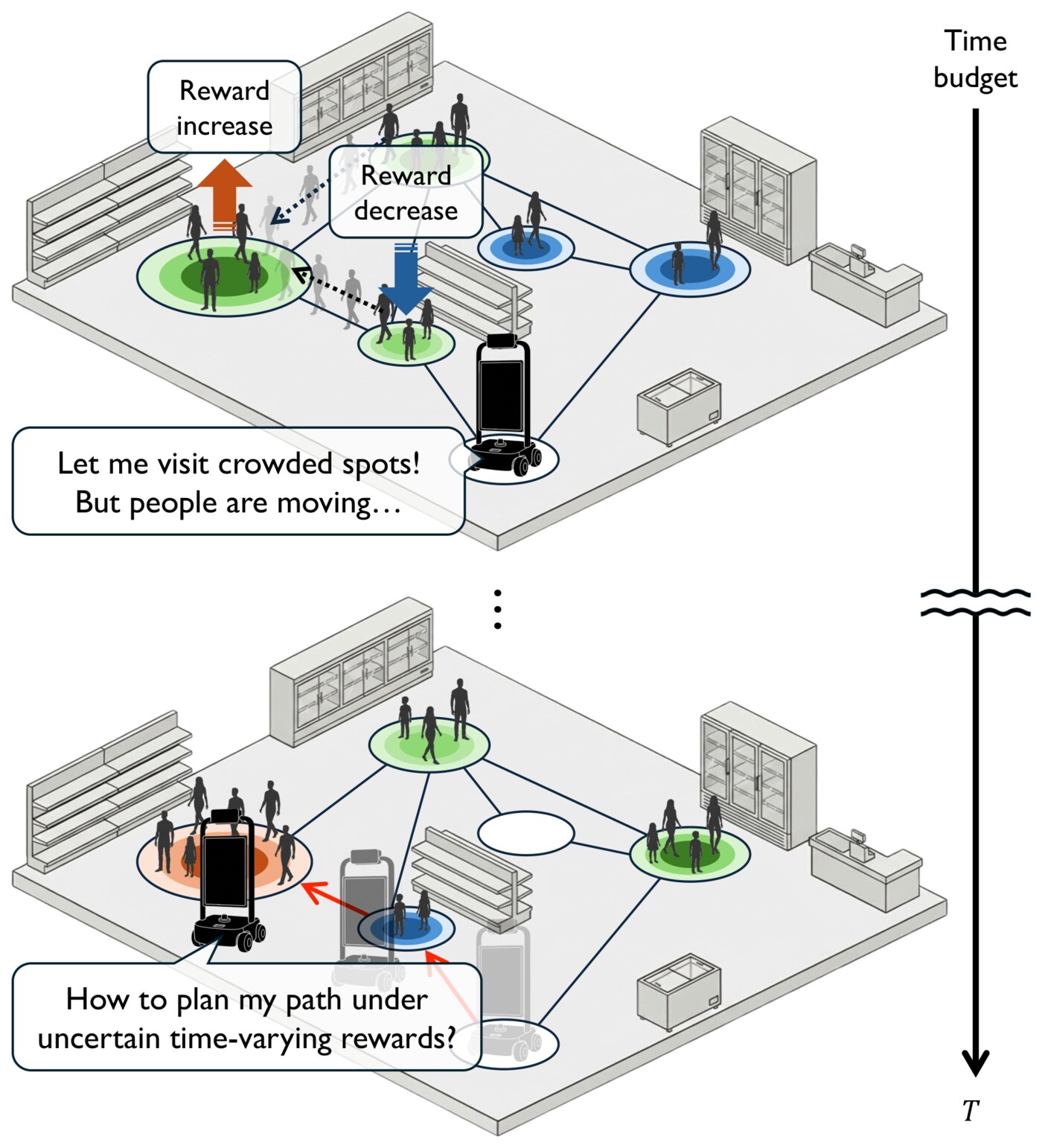
We present the orienteering problem with uncertain time-varying rewards (OP-UTVR), a novel variant of the orienteering problem (OP). While most existing OP formulations assume rewards to be known in advance, practical applications involve uncertain and time-varying rewards, as with shifting customer demand for delivery agents. OP-UTVR relaxes this assumption by allowing agents to estimate reward dynamics from observations and forecast future rewards. This enables informed routing decisions despite stochastic reward changes and inevitable prediction errors. We address this problem using three planners that differ in planning horizon and online adaptivity, and derive theoretical bounds on their performance under reward stochasticity. We further introduce a mobile service robot benchmark for OP-UTVR, where a robot navigates among pedestrians in indoor environments. Experiments reveal trade-offs between planning horizon and adaptivity, and demonstrate the effectiveness of long-horizon planning with online adaptation.
Sci. Rep.

Deep Probabilistic Traversability with Test-time Adaptation for Uncertainty-aware Planetary Rover Navigation

M. Endo, T. Taniai, and G. Ishigami

Scientific Reports, 2026

Paper arXiv
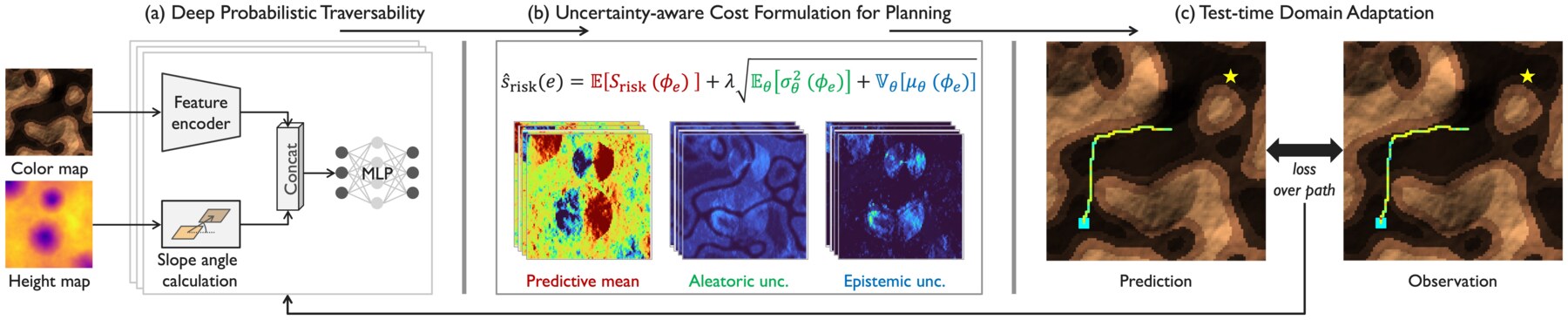
Traversability assessment of deformable terrain is vital for safe rover navigation on planetary surfaces. Machine learning (ML) is a powerful tool for traversability prediction but faces predictive uncertainty. This uncertainty leads to prediction errors, increasing the risk of wheel slips and immobilization for planetary rovers. To address this issue, we integrate principal approaches to uncertainty handling — quantification, exploitation, and adaptation — into a single learning and planning framework for rover navigation. The key concept is deep probabilistic traversability, forming the basis of an end-to-end probabilistic ML model that predicts slip distributions directly from rover traverse observations. This probabilistic model quantifies uncertainties in slip prediction and exploits them as traversability costs in path planning. Its end-to-end nature also allows adaptation of pre-trained models with in-situ traverse experience to reduce uncertainties. We perform extensive simulations in synthetic environments that pose representative uncertainties in planetary analog terrains. Experimental results show that our method achieves more robust path planning under novel environmental conditions than existing approaches.
ICRA 2025

Risk-aware Integrated Task and Motion Planning for Versatile Snake Robots under Localization Failures

A. Jasour*, G. Daddi*, M. Endo*, T. S. Vaquero*, M. Paton, M. P. Strub, S. Corpino, M. Ingham, M. Ono, and R. Thakker

IEEE International Conference on Robotics and Automation (ICRA), 2025

arXiv

* equal contribution

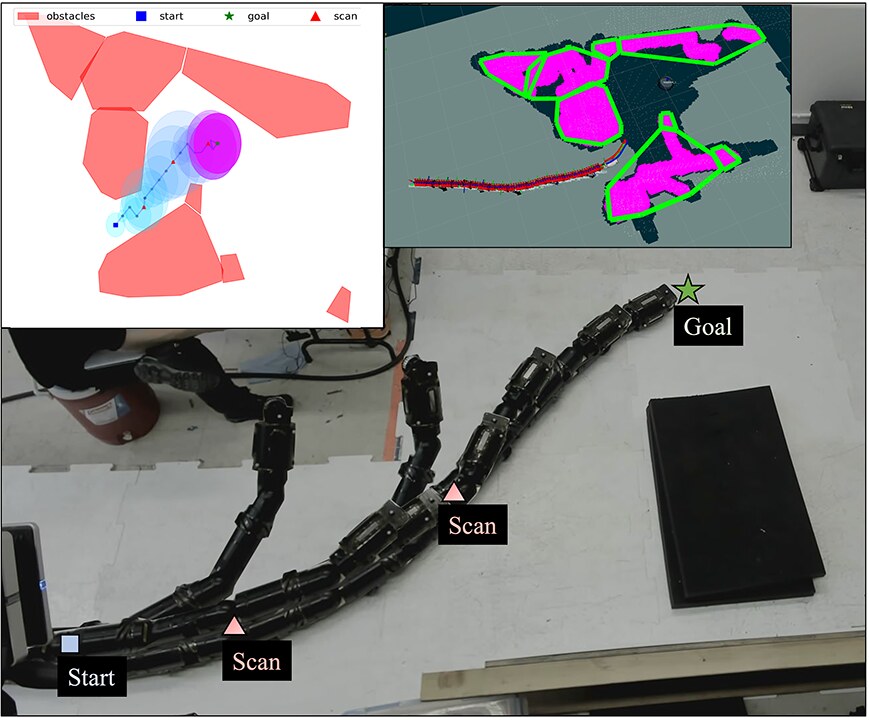
Snake robots enable mobility through extreme terrains and confined environments in terrestrial and space applications. However, robust perception and localization for snake robots remain an open challenge due to the proximity of the sensor payload to the ground coupled with a limited field of view. To address this issue, we propose Blind-motion with Intermittently Scheduled Scans (BLISS) which combines proprioception-only mobility with intermittent scans to be resilient against both localization failures and collision risks. BLISS is formulated as an integrated Task and Motion Planning (TAMP) problem that leads to a Chance-Constrained Hybrid Partially Observable Markov Decision Process (CC-HPOMDP), known to be computationally intractable due to the curse of history. Our novelty lies in reformulating CC-HPOMDP as a tractable, convex Mixed Integer Linear Program. This allows us to solve BLISS-TAMP significantly faster and jointly derive optimal task-motion plans. Simulations and hardware experiments on the EELS snake robot show our method achieves over an order of magnitude computational improvement compared to state-of-the-art POMDP planners and >50% better navigation time optimality versus classical two-stage planners.
ICRA 2023

Risk-aware Path Planning via Probabilistic Fusion of Traversability Prediction for Planetary Rovers on Heterogeneous Terrains

M. Endo, T. Taniai, R. Yonetani, and G. Ishigami

IEEE International Conference on Robotics and Automation (ICRA), 2023

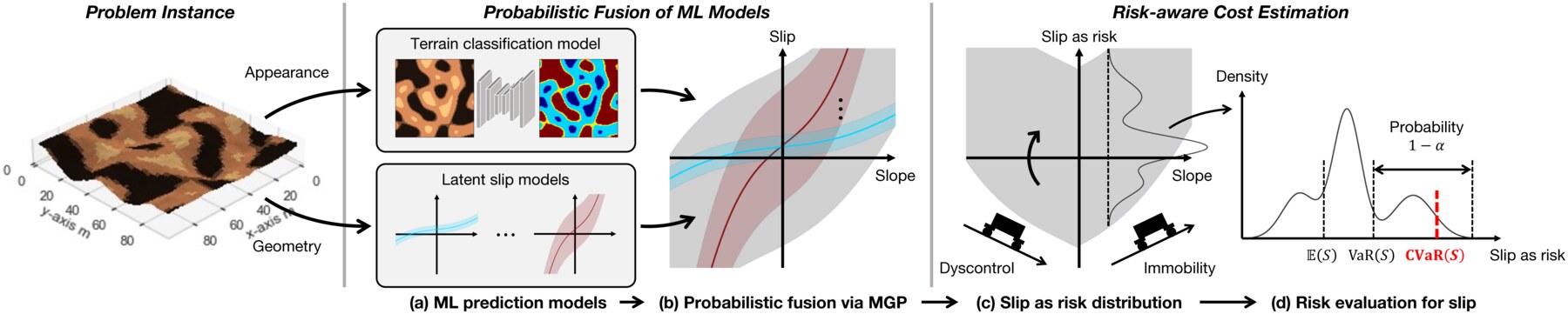
Machine learning (ML) plays a crucial role in assessing traversability for autonomous rover operations on deformable terrains but suffers from inevitable prediction errors. Especially for heterogeneous terrains where the geological features vary from place to place, erroneous traversability prediction can become more apparent, increasing the risk of unrecoverable rover's wheel slip and immobilization. In this work, we propose a new path planning algorithm that explicitly accounts for such erroneous prediction. The key idea is the probabilistic fusion of distinctive ML models for terrain type classification and slip prediction into a single distribution. This gives us a multimodal slip distribution accounting for heterogeneous terrains and further allows statistical risk assessment to be applied to derive risk-aware traversing costs for path planning. Extensive simulation experiments have demonstrated that the proposed method is able to generate more feasible paths on heterogeneous terrains compared to existing methods.
RA-L 2022

Active Traversability Learning via Risk-aware Information Gathering for Planetary Exploration Rovers

M. Endo and G. Ishigami

IEEE Robotics and Automation Letters, vol. 7(4), pp. 11855–11862, 2022 (presented at IROS 2022)

Paper
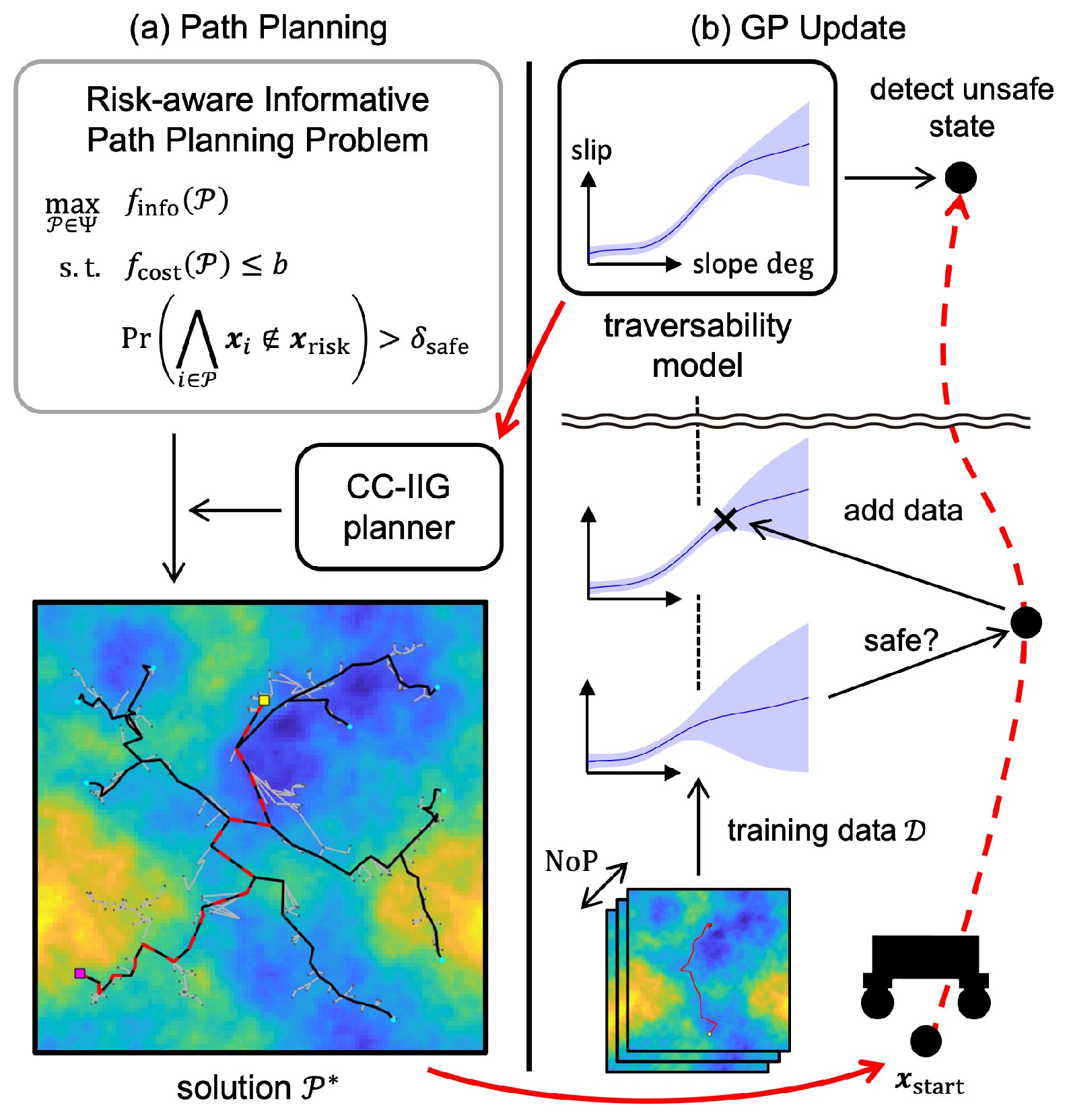
Traversability prediction enables safe and efficient autonomous rover operation on deformable planetary surfaces. Revealing spatial distribution from terrain geometry to rover slip behavior is key to assessing prospective traversability, but is hindered by insufficient in situ measurements on hazardous states due to conservative rover traverses. To achieve a more accurate prediction, this letter proposes a framework that actively learns latent traversability by exploring informative terrain under the constraints of stochastic rover slip. With a Gaussian process (GP) modeling the spatial distribution, we devise an iterative two-stage framework that gradually refines the model estimation, combining risk-aware informative path planning and GP updates by taking in situ measurements. The path planning stage employs our designed sampling-based algorithm to generate informative trajectories with fault-tolerant risk inference, while the GP is cautiously updated with traverse data to avoid rover immobilization. Chance constraint formulation is exploited in the framework to infer the stochastic reachability of informative regions. Through GP estimates reducing uncertainty, the algorithm incrementally reaches informative yet hazardous states along feasible trajectories. Simulation studies in rough terrain environments demonstrate that the proposed framework gathers informative traverse data while averting rover stuck situations to estimate the latent traversability model.

All Publications

See also Google Scholar.

Preprints

  1. ReVNM: Learning-Based Visual Navigation from a Remote Camera
    M. Eguchi*, K. Honda*, M. Endo, Y. Yoshimura, and R. Yonetani (* equal contribution)
    arXiv, 2026
  2. Commonsense-Grounded Path Planning from Abstract Instructions
    M. Endo, K. Honda, and R. Yonetani
    arXiv, 2026
  3. Orienteering Problem with Uncertain Time-Varying Rewards: Framework and Benchmark for Everyday Service Robotics
    M. Endo, K. Honda, Y. Jinnai, and R. Yonetani
    arXiv, 2026

Journal Papers

  1. Deep Probabilistic Traversability with Test-time Adaptation for Uncertainty-aware Planetary Rover Navigation
    M. Endo, T. Taniai, and G. Ishigami
    Scientific Reports, 2026
  2. Active Traversability Learning via Risk-aware Information Gathering for Planetary Exploration Rovers
    M. Endo and G. Ishigami
    IEEE Robotics and Automation Letters, vol. 7(4), pp. 11855–11862, 2022
  3. Accurate Prediction of Machining Cycle Times by Data-driven Modelling of NC System's Interpolation Dynamics
    M. Endo and B. Sencer
    CIRP Annals, vol. 71(1), pp. 405–408, 2022
  4. Terrain-dependent Slip Risk Prediction for Planetary Exploration Rovers
    M. Endo, S. Endo, K. Nagaoka, and K. Yoshida
    Robotica, vol. 39(10), pp. 1883–1896, 2021

Conference Papers

  1. DRPA-MPPI: Dynamic Repulsive Potential Augmented MPPI for Reactive Navigation in Unstructured Environments
    T. Fuke, M. Endo, K. Honda, and G. Ishigami
    IEEE International Conference on Automation Science and Engineering (CASE), 2025
  2. Risk-aware Integrated Task and Motion Planning for Versatile Snake Robots under Localization Failures
    A. Jasour*, G. Daddi*, M. Endo*, T. S. Vaquero*, M. Paton, M. P. Strub, S. Corpino, M. Ingham, M. Ono, and R. Thakker (* equal contribution)
    IEEE International Conference on Robotics and Automation (ICRA), 2025
  3. Towards Local Minima-free Robotic Navigation: Model Predictive Path Integral Control via Repulsive Potential Augmentation
    T. Fuke, M. Endo, K. Honda, and G. Ishigami
    IEEE/SICE International Symposium on System Integration (SII), 2025
  4. BenchNav: Simulation Platform for Benchmarking Off-road Navigation Algorithms with Probabilistic Traversability
    M. Endo, K. Honda, and G. Ishigami
    IEEE ICRA 2024 Workshop on Resilient Off-road Autonomy, 2024
  5. Risk-aware Path Planning via Probabilistic Fusion of Traversability Prediction for Planetary Rovers on Heterogeneous Terrains
    M. Endo, T. Taniai, R. Yonetani, and G. Ishigami
    IEEE International Conference on Robotics and Automation (ICRA), 2023
  6. Traveling State Estimation of a Wheeled Robot using ToF Camera and Torque Sensor for Lunar/Planetary Exploration
    S. Endo, M. Endo, K. Nagaoka, and K. Yoshida
    JSME Conference on Robotics and Mechatronics, 2P1-T03, 2019
  7. Quality of the 3D Point Cloud of a Time-of-flight Camera Under Lunar Surface Illumination Conditions: Impact and Improvement Techniques
    K. Uno, L.-J. Burtz, M. Endo, K. Nagaoka, and K. Yoshida
    International Symposium on Artificial Intelligence, Robotics and Automation in Space (i-SAIRAS), 2018

Presentations

  1. Active Traversability Learning via Risk-aware Information Gathering for Planetary Exploration Rovers
    M. Endo and G. Ishigami
    IEEE/RSJ IROS, Kyoto, Japan, Oct. 2022
  2. Machining Cycle-time Prediction by Machine Learning of CNC Interpolator Dynamics
    M. Endo and B. Sencer
    International Manufacturing Science and Engineering Conference, OH, USA, Jun. 2021
  3. Microsatellite Bus System Technologies of Tohoku University
    T. Kuwahara, Y. Sakamoto, S. Fujita, Y. Sato, R. Taba, H. Katagiri, M. Endo, P. Tangdhanakanond, T. Honda, and K. Yoshida
    IAA North East Asia Symposium on Small Satellites, Ulaanbaatar, Mongolia, Aug. 2017

Experience

Education

Service

  • Reviewer: ICRA (2023, 2024, 2026, 2027), IROS (2022–2026), RA-L, T-RO, IEEJ Trans.
  • Teaching Assistant: ME 413, Oregon State University (Spring 2020)

Fellowships & Awards

  • JSPS Overseas Challenge Program for Young Researchers (2024)
  • JSPS Research Fellowship for Young Scientists DC1 (2022–2025)
  • JEES / Mitsubishi Corporation Scholarship (2023–2024)
  • Keio Research Encouragement Scholarship (2023, 2024)
  • Keio Fujiwara Scholarship (2021)
  • NSF NAMRC 49 / MSEC 2021 Student Support Award (2021)